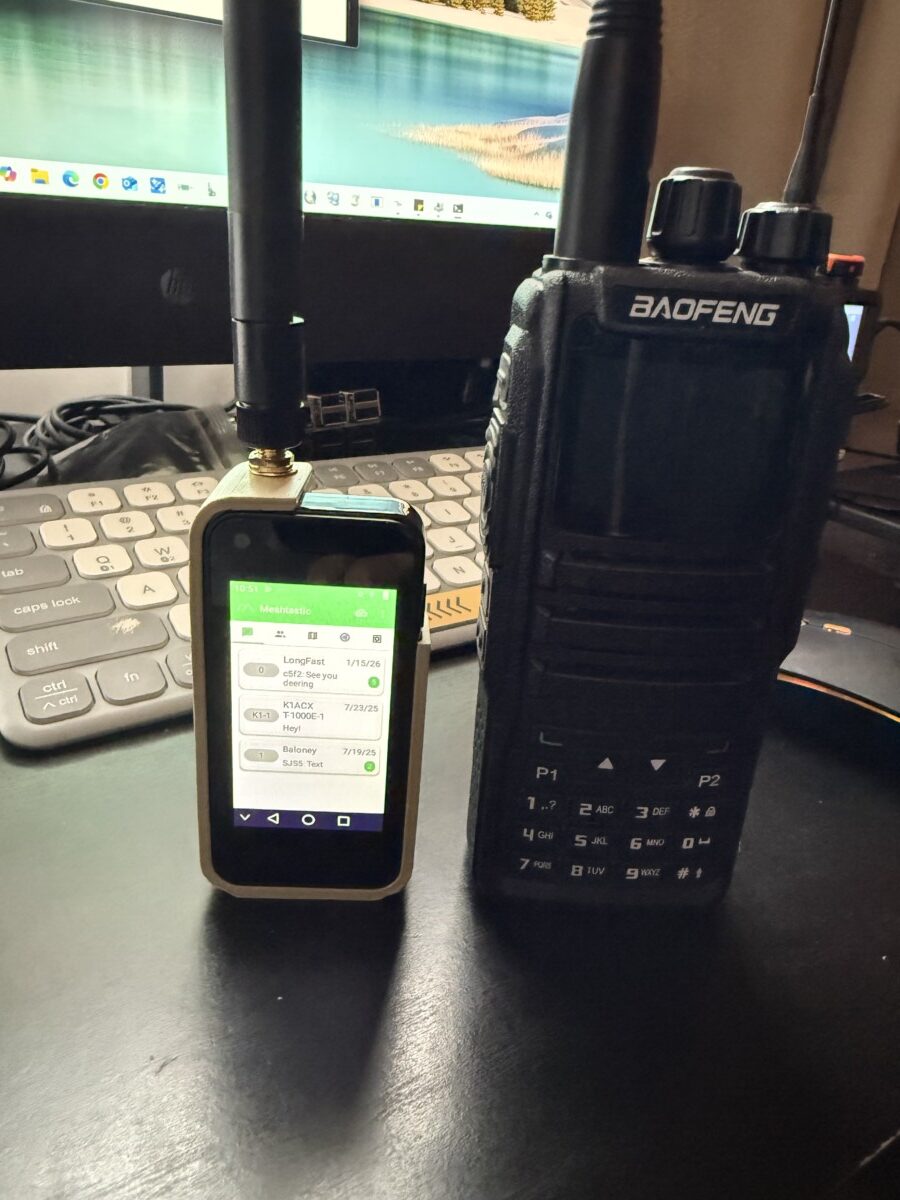
Very cool concept, not so much in execution.
It seems like most of my reviews so far have been kind of negative. I feel bad about that. Not because I’m dumping on a product, but because I have so many devices that just aren’t all they proclaim to be. If you haven’t guessed, this is another one.
The Spec5 Spectre is a portable Meshtastic device sold by SpecFive LLC (why they interchange “Five” and “5” I do not know, but they do). Described as an Android Off-Grid Mesh Connectivity Phone, a unique combination of Android smartphone features and advanced LoRa mesh technology. This is accurate. It is a Haltek V3 LoRA device, with a battery, in a 3D case that also comes with an Android phone and a stubby little antenna that is typical for Mesh clients. It is shipped ready to go, power it on and get mesh’n, it even comes with a couple Meshtastic games and two USB-C data\charging cables that while short at about 10″, are beefy and appear to be well-made. Yes, it has two identical cables, you’ll see why shortly, and it’s not in case you lose one. It’s not cheap at $144 but on paper, if you are looking for a portable, convenient, and all-in-one mesh device that with a SIM card can also be a phone , this looks pretty damn good with Wifi and GPS.
Unlike a lot of pre-built mesh devices, this isn’t square and flat, it is rectangular, relatively narrow, and rather thick. You can see in the featured pic of this post it is quite a bit smaller than a typical HT – not that they should be the same size but it is a good reference for size than say “about 3/4 of a Snickers bar.” That also works, just sayin’. The front is the phone, the back shows the typical small display that you would find on many basic mesh devices. I like that they didn’t skip this or hide it since if you ever need to re-pair it to the phone (like I said, it comes ready to go so already paired), you’ll need that display for the pairing key. On the left side is a small slide switch to turn on the Haltek, which fires off quickly as expected with this board. The charging circuit is wired through the switch and has to be on to charge the battery for the mesh device, which is separate from the phone. Not ideal, I’m sure they had their reasons for doing it this way instead of letting you charge the battery without it being on. More than once I have had it charging, unplugged it, and since the phone was off I didn’t pay attention that the mesh was powered on. Next time I went to use it… battery dead. Fortunately it charges fast. Unfortunately it is a small battery and discharges fast. Expect 2-3 hours of life out of it powered on. In contrast, my Seeed T1000e that is smaller than this – though needs to be paired with a phone that isn’t included – will run easily 36-48 hours before needing a charge. Then again, it isn’t running a tiny display.
It is a Haltek, arguably the most-used Meshtastic and Meshcore board out there. Don’t bother asking “does it work on the mesh” because of course it does. There’s a reason beside price that the Haltek is so popular: it works and it is supported universally. Setup your configuration that fits your mesh needs, reboot, BOOM, beacons are going out, messages are coming in. No, it doesn’t have a GPS module or WiFi, but that’s what the phone is for, it has both. Though I put a high-gain (5db) antenna with a nifty folding joint built in, the stock stubby one wasn’t that bad. The 3d-printed case is thick and sturdy, never concerned that dropping it would cause catastrophic destruction.
So, at this point besides the battery life, it sound good, right? I mean it works and it uses a universally-supported board. What is the problem?
Glad you asked. There’s two problems, one more of an inconvenience than a real problem. The other? Oh boy…
To ease into the pain, let’s start with the inconvenience: charging. Remember the 2 cable things? That’s because the Haltek has a battery and the phone has a battery. The are isolated from each other which means you have to charge them separately. On the plus side, they both charge USB-C. In a perfect world, where phone batteries last longer than a few hours, this wouldn’t be an issue. You charge or power the mesh device while using it, then at the end of the day or in a couple of days, pop the cable over to the phone and charge that.
This is not a perfect world. The battery in the phone is also small. It lasts about the same as the mesh device. That almost seems convenient until you remember you need two free USB ports within 20″. If you are by a PC, great. If you are in your car, maybe not so great. Same with a small battery brick.
Time to address the pigmy elephant in the room. If it was just a small battery in the phone that was an issue, I could move past that pretty easy. Unfortunately, the draw to this device, the reason someone might be willing to pay $150 for one is the built-in phone. The phone is the draw and the death of the Spectre. Even if it was the battery and just one of the other things, it might almost be still worth the cost of entry. Alas, it isn’t just one other thing.
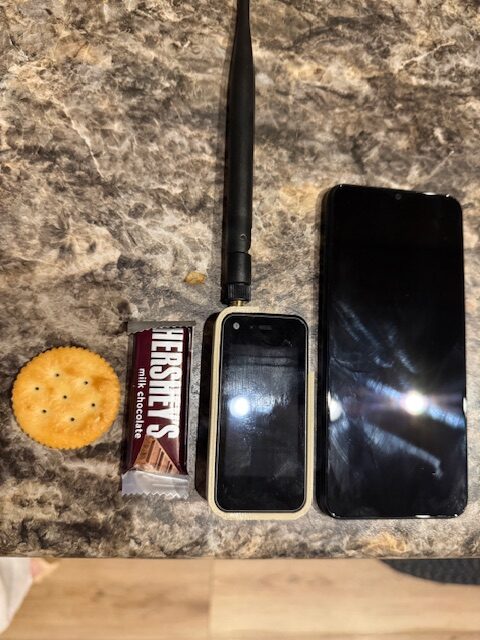
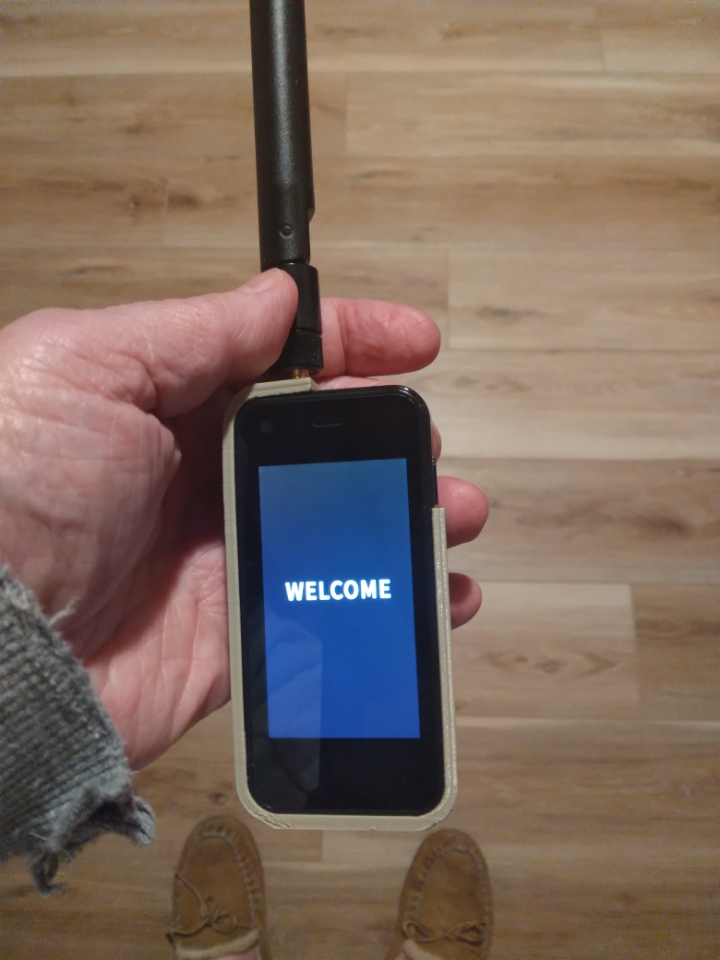
This thing is small, like really small.
Maybe that doesn’t sound bad, even a perk, right? WRONG. Not only is it so small that it is difficult to see the text even with the brightness cranked and bifocals, step back and think about what you do with a phone. One with a touchscreen. One that is for text operation. That you have to tap with your fingers. Look at the pic below. That’s a standard-sized Samsung smart phone – A02S – next to the Spectre. And just in case that wasn’t contrast enough, that’s a normal Ritz cracker and a fun-sized Hershey bar. Look how small it looks in my hand in the second pic. I’m 5’2″. That’s not a big hand. That’s not even a normal sized man hand. Now think about just how tiny the full-key keyboard is. Yeh. Typos are the rule, getting one word right is the exception. I tried using a stylus – both the blunt inductive type and a pointed powered one – and that helped a bit, but also highlighted another issue. The touch screen doesn’t respond at the edges. Before you think this is just maybe a lemon or a one-off, I got two of these things so that I could have one and my wife the other. They both have the same issue.
All of the above is compound by the reality that this phone is slow as death by old age. Slow as riding a bicycle up Mt Washington. Slow as a sloth crawling through- you get the point. It is horrifically slow. You don’t even know you made a typo for several seconds because takes forever for the damn thing to respond. You’re not even sure it hasn’t locked up it takes so long to respond.
SpecFive (or 5) states this is “designed for those who need reliable communication even in the most remote locations. This device is perfect for outdoor enthusiasts, emergency preparedness, and anyone who needs dependable connectivity away from traditional cellular networks.” Those are pretty lofty statements for a device that is 2g/3g and has the above issues. It is a novel idea that they look like they have expanded on with the Spectra Pro – a 3.88″ quad core LTE capable device with carbon fiber case. At $209;99, it also isn’t cheap but might end up being a better value. They also have the Ranger, no phone but a ful QWERTY keyboard for $179.99. Not interested in the Ranger but maybe if the price of groceries ever eases, I’ll pony up for the Spectre Pro and give it a spin.

Author: Scott
General class operator
No responses yet