40W from an HT? Where do I sign up?
The BTECH UHF and VHF amps – if you get the D model(s) they are true TDMA Tier2 DMR amplifies as well as analog. At the time of this post a unit is $99 direct from BTECH for the analog amps, $115 for either of the digital-capable ones. Like the UV Pro and UV-50 Pro, these are rebranded VGC amps sold in the US by BTECH. From experience with both my UV Pro and VR-N7500 mobile, I was cautiously optimistic about this unit.
There are 5 models:
– U25 Analog 70cm
– U25D Analog and digital 70cm (DMR, P25 Phase 1, C4FM, NXDN, IDAS, dPMR, MPT1327)
– V25 Analog 2m
– V25D Analog and digital 2m (DMR, P25 Phase 1, C4FM, NXDN, IDAS, dPMR, MPT1327)
– AMP-220 Analog 1.25m
There are a few important things go note before you take the plunge. Let’s get into it.
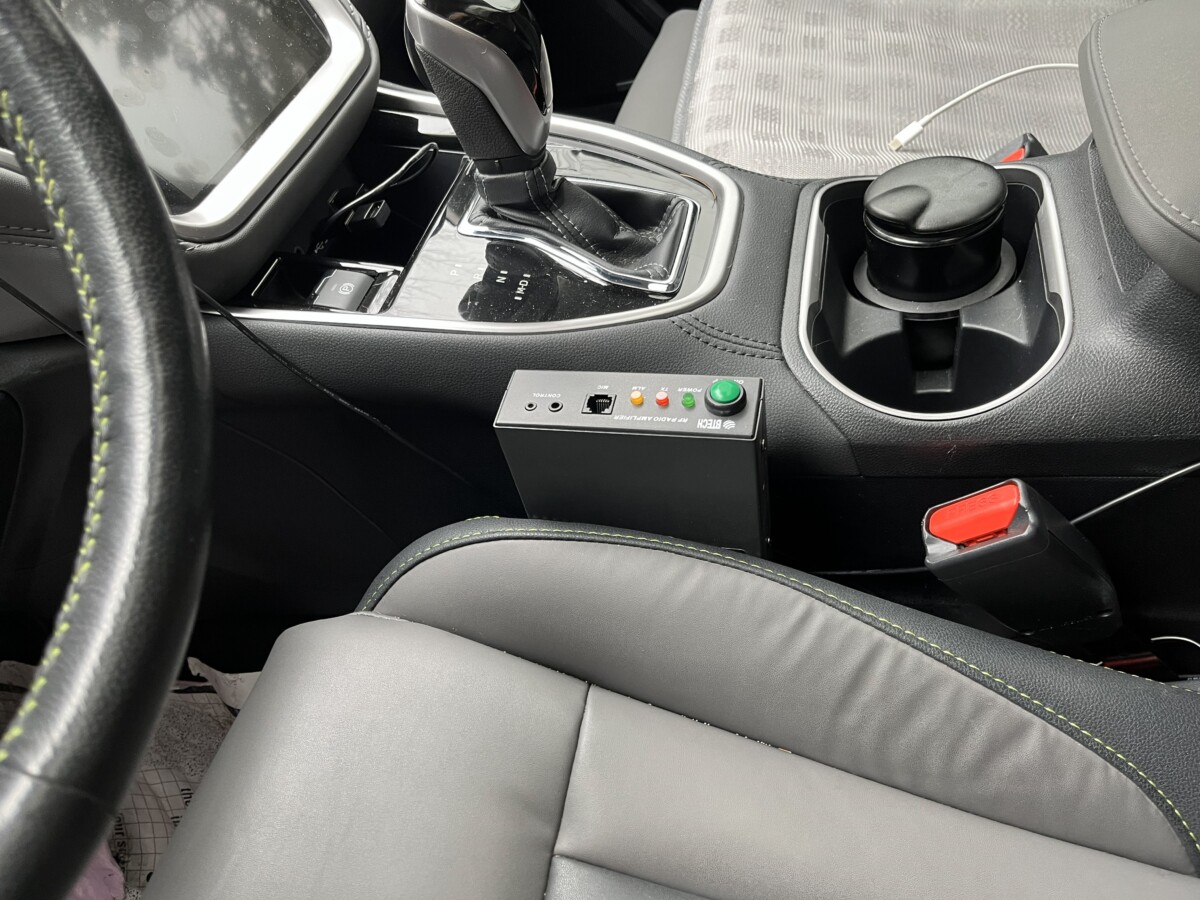
This an average-sized unit at 5.5″x4.5″x1.5″ with a 4W speaker mounted on the top and comes with the SMA cable to connect to the radio, a K1 cable for PTT (optional), an RJ-45 hand mic (optional), a 6′ fused unfinished power lead, and mounting bracket. Mounting is as easy as any mobile radio, and since it is functionally headless, the mounting location in a vehicle is a bit more flexible. Unfortunately, the supplied K1 and SMA cables 4′ so that is a limiting factor. Longer SMA cables are readily available (there’s nothing special about the OEM one other than it is pretty thin and flexible) but I have yet to find a replacement K1 cable – even an OEM one – so if that breaks or you need more runway, you are making one.
You probably made note of the two “optional” items above. That is because this unit has three different ways it can be configured for operation. The only constant is the SMA cable that connects to the back of the amp and to the SMA connector on the radio. Regardless of configuration, channel switching and volume are controlled by the HT. No special configuration (VOX, etc.) is required of the radio in any of the configurations.
- Just the SMA connecting the radio to the amp. RX and TX are handled by the HT. Output only is handled by the amp. This is the simplest mode, but you are tethered to the amp with a relatively short cable, at least it is as flexible as cooked spaghetti. One way around this is to use a hand mic connected to the HT (wired or BT). Sound quality is 100% dependent on the HT\speaker mic.
- SMA connecting the radio to the back of the amp, the K1 cable to the front of the amp. RX sound is via the amp speaker, PTT is via the HT. This is in my opinion, the least convenient due to being tethered by two cables and no speaker mic option.
- Same as #2 but with the supplied RJ-45 hand mic (no speaker) that plugs directly into the front of the amp. This is how I run it most of the time as it is – for me – the most convenient\least bulky way that also allows seeing the HT screen no matter what.
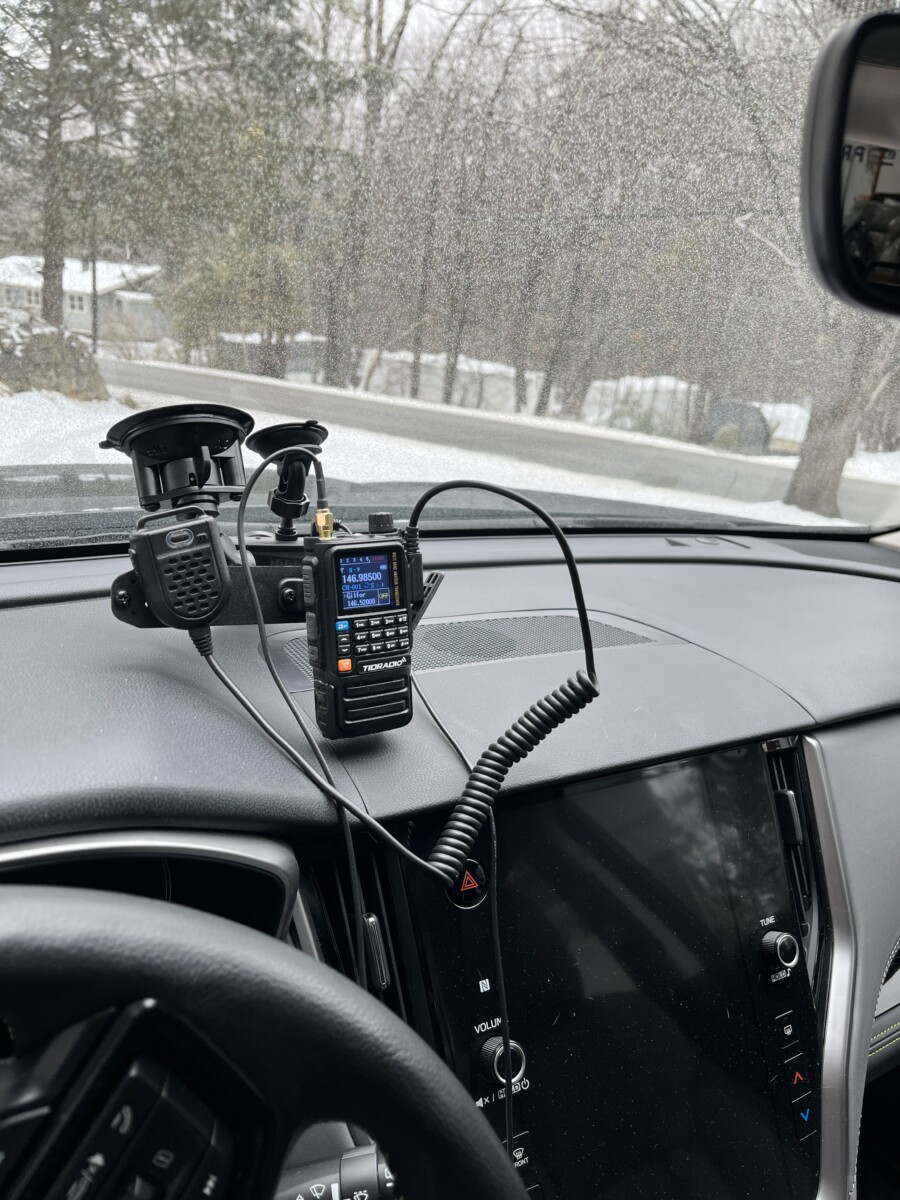
The amp will – in theory – push output of an HT to anywhere between 20W and 40W, depending on the power output of the HT. It will amplify a max of 6W input, you can use a radio capable up to 10W without damage, though any input higher than 6W is throttled down to 6W. For example, a 6W HT attached set a low power putting out a theoretical 2W will put out 20W at the antenna. Set it at medium at 4W and that’s 30W output, 6W on high is 40W output.
In theory.
In practice, the results I got were not quite there on the low end and a bit more on the high end. I tested this amp with a variety of CCRs (TiDRADIO H3 Plus (5W), UV5x3 (5W), UV K6 Pro (10W), UV32 Pro (8W), DM-1701 (5W), UV5RH Pro (5W), UV-25 Pro (on medium power since this is a 11W HT), and with an adapter cable since it doesn’t use a standard K1 port, a UV Pro (5W).
I saw a low of 18.3W from the UV5x3 (the H3 Plus was barely better at 18.4W) on low power to a high of 46.7W from the K6 and UV-25 Pro. The DM32 was a little less at 45.9. Still noticeably better than the advertised high, and considering the quality of radio of the two low numbers, I won’t dock the amp on less than 20W since the radios are hot garbage (UV5x3) to flaming stinking hot garbage (H3 Plus). I tested on analog 146.520 and to a repeater on 146.985000 analog and DMR.
THING TO NOTE #1 – Only the two analog models are dual band. Damage to any of them will occur if TX is done with the unit powered on and not in the designed band. The analog models will TX\RX on the other band if the amp is powered OFF. Due to the circuit switching design of DMR Tier II and P25 Phase 2, the D models only operate on their designated band, regardless of power state.
Sound quality on RX through the amp speaker is as good as a 4″, 4W speaker is expected to give. Even at max radio volume, it didn’t break up or distort. TX reports were good to excellent. More than one occasion I got comments like “wow, that’s a great sounding mobile.” I didn’t correct them with what I was running, I’m not sure they would have believed me when giving me 5-9 reports on a repeater over 50 miles away. I got similar reports using both a Tram 11862S mag mount on the roof of a 2024 Subaru Outback or Tram 1191 thru-glass on the same car (look for a review of that antenna in the future). I was able to pull in a few more faint stations with the 11862S on the roof of a 1979 VW Bus due to the very large ground plane (that’s my story and I’m sticking to it).
THING TO NOTE #2 – BTECH advertises “harmonic filters for cleaner output” which, let’s be honest, with some of the CCRs, ANYTHING would help. This helps. Significantly. I was staggered. Several of the radios I tested were already pretty clean, significantly below -60db across all the harmonics without the amp. They saw marginal improvement. What blew me away was my two dirtiest radios – the UV5x3 and H3 Plus, both tickling -60db on the first harmonic on 146.520 – saw a massive improvement, not breaking over -80db. Since db is logarithmic, that’s a HUGE improvement.
THING TO NOTE #3 – While it is always best to run higher-powered DC devices direct to the battery, the amperage draw while transmitting at max wattage was bouncing around the 8A range, safely below the 10-15A limitation of most auto OEM 12v outlets. This wasn’t a permanent installation in my car so I put a ciggy plug on the lead and after a 30 minute net, the 12v outlet in the console of my Outback was barely warm to the touch. The case got warmer than the plug, yet that was still plenty comfortable to the touch. I plan to mount this in my VW Bus since the only ham radio in it currently is a circa 1980 Radio Shack 50W 70cm (which fits the vibe of the ancient rig) and hide it under the seat.
THING TO NOTE #4 – Since this works with any HT that has an SMA antenna port, you are not limited to one radio in your rig or shack. Want to do DMR? Pop on a DM-1701 or DM32 (or whatever you use for DMR) for a bit, then take that off and put on a N76\UV Pro and start doing digital modes while chewing on analog.
THING TO NOTE #5 – I strongly recommend replacing the OEM SMA cable with a beefier one if you plan to swap radios around (I got one that is SMA on the amp side, BNC on the radio side since I’ve converted all my HTs to BNC), I have low confidence on the longevity of the OEM cable with frequent moving it around. It does have strain reliefs but still, it’s not much thicker than angel hair pasta. Eventually I’ll figure out the pinout for the K1 cable so I can make a backup. Possibly one of those that are used for simplex repeater setups with a couple of Baofengs might work, dunno. More research needed.
TL:DR – For the price of a decent mobile (though not high end), this amp has some pretty strong pros on its side, specifically cleaning up SEs, versatility, low power consumption, and reasonable size. Unlike a decent priced mobile, you are locked into one band in the worst case, and two bands with one being on HT power in the best case. Depends on your needs. Since I rarely key on 440, this works for me. Your mileage may vary.

Shop for the BTECH amp on Baofeng Tech website by clicking on the image above. This is an affiliate link, AARN may receive a commission from any purchase made with BTECH using this link.

Author: Scott - KC1MUR
General class operator
No responses yet