Alliance Amateur Radio Network
QRV Monthly
Member Newsletter
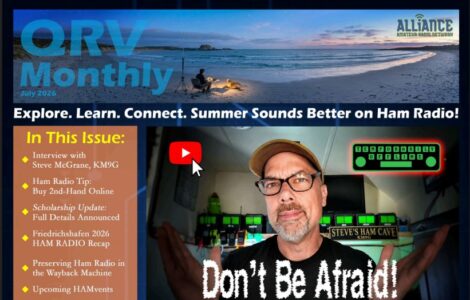
Don’t Be Afraid: Making Ham Radio Feel Like Home
A Conversation with Steve McGrane, KM9G — creator of Temporarily Offline and the Toads Digital Interface Board
Every so often a conversation reminds you why this hobby is worth sharing. That’s exactly what happened when we sat down with Steve McGrane — creator of the Temporarily Offline YouTube channel and the Toads Digital Interface Board — for the latest AARN interview. What started as a conversation about radios turned into something much bigger: a conversation about belonging.
The Person Behind the Call Sign
Before he was known for his how-to videos and radio reviews, Steve had already lived a handful of lives. He built a career in IT, burned out on corporate America, started a small farm raising cows, pigs, and sheep, worked as a driver instructor, and picked up a firearms instructor certification along the way. Ham radio came later — deeper, this time — and eventually became a full-time pursuit through YouTube.
That eclectic path shaped how he teaches. He doesn’t chase perfection or pretend to know everything. As he put it, he tries not to say things unless he actually knows them — and when he doesn’t, he says so plainly. It’s a small habit, but it’s part of what makes his content, and his presence in the community, feel trustworthy rather than performative.
Content With a Purpose
Steve publishes roughly three long-form videos and seven shorts a week, and he’s candid about the grind of it — chasing an audience that the platform doesn’t always show his work to. But his approach to teaching stands out: rather than reading a spec sheet at the camera, he tries to build understanding through demonstration, admitting there’s rarely just one “right” way to do something in this hobby. That mindset — there’s more than one way to do it, and neither person is wrong — is worth holding onto, especially for anyone new who’s worried about doing things the “correct” way.
Failure Is Part of the Curriculum
One of the most valuable threads in the conversation was Steve’s comfort with things going wrong. He talked about buying gear at hamfests that turned out to be broken, and how that simply becomes a different project rather than a disappointment — because, as he said, it was already broken, so you can’t make it worse. That same philosophy extends to newcomers plugging in their first radio, wiring their first antenna, or fumbling their first contact. Mistakes aren’t a detour from learning amateur radio — they are amateur radio.
He shared a story about a friend who inherited a radio from a family member and was too afraid to even turn it on. Steve’s take: if you do it right, you’ve explored a new hobby. If you do it wrong, you’ve explored the hobby of fixing what you just broke. Either way, you’ve learned something, and almost everything is repairable if you’re willing to put in the effort.
Rethinking How We Welcome New Operators
This is where the conversation lined up closely with what AARN believes about this hobby. Steve floated an idea for how the entry-level licensing experience could work: pair the legal requirements — the parts of the hobby you have to memorize, like frequency privileges and identification rules — with genuine hands-on practice. Let a new operator assemble a station, make a supervised first contact, and troubleshoot a simple problem (like a power supply that can’t handle transmit current) in a low-stakes setting before they’re ever on their own. His point was simple: technical knowledge sticks faster and lasts longer when it’s paired with a safe place to fail.
That’s a message AARN carries into every net we run and every newcomer we welcome. The technical material is one hurdle. Feeling like you belong in the room — or on the frequency — is often the bigger one.
Community Over Equipment
Asked whether friendships in ham radio have become as important as the technology itself, Steve didn’t hesitate. He described skipping the equipment tables at big hamfests to instead spend his time putting faces to call signs and hearing people’s stories. He’s also involved in organizing a multi-day gathering before the Huntsville Hamfest, where participants work together on Parks on the Air activations, build common-mode chokes, solder projects, and this year, even learn astrophotography. It’s less about the gear in the room and more about who you’re building it with.
He also spoke warmly about mentorship — not just the operators who helped him directly, but the broader community of creators on YouTube who became what hams call an “Elmer” from a distance. Knowledge passed forward, freely, is what keeps this hobby alive across generations.
Don’t Be Afraid
When asked for one piece of advice for a brand-new operator, Steve’s answer was immediate: don’t be afraid. Turn the radio on. Make the contact. Get it wrong if you have to. Everything on the other side of that fear is where the actual hobby lives.
That’s a message worth repeating to every newcomer AARN talks to — whether you earned your call sign last week or forty years ago, whether you found this hobby through engineering, a family member, emergency communications, or pure curiosity. There’s room for you here, mistakes and all.
Join the Alliance Net
Wednesdays @ 9 PM Eastern
Buying 2nd-Hand Online? Protect Yourself.
Second-hand marketplaces and ham radio social-media groups are a great way to find gear at a good price — but they’re also a favorite hunting ground for scammers.
The good news is that a few simple steps before you send payment can save you from becoming a victim.
Before You Pay, Ask For:
- Clear, well-lit photos of the actual equipment — not screenshots or stock manufacturer photos.
- A photo with a piece of paper next to the radio showing the seller’s name, today’s date, and your name or callsign. This proves they actually have the item in hand right now.
- Sharp, in-focus photos of the serial number label and model information. If the seller’s photos of the serial number are blurry or oddly out of focus, treat that as a red flag.
- Photos from multiple angles — connectors, battery contacts, display, microphone, accessories, and any cosmetic damage.
- A short video of the radio powering on, transmitting (if applicable), receiving, and navigating through the menus.
- If programming software or accessories are included in the sale, ask to see those in the photos too.
How You Pay Matters Just as Much
Use a payment method that offers buyer protection — PayPal Goods & Services or a credit card are your best bets. Avoid Friends & Family, Zelle, Cash App, Venmo, wire transfers, gift cards, or crypto unless you personally know and trust the seller.
Check the Seller’s Profile
A brand-new account, little to no activity, or a history that doesn’t match what they’re selling all deserve a closer look before you commit.
And Trust. Your. Gut.
If a seller refuses reasonable requests for more photos or video, or is pushing you to pay immediately, walk away. If the price seems too good to be true, it almost always is — there will always be another radio for sale. Losing out on a “great deal” beats losing your money every time.
Stay safe out there, and happy hunting for your next rig!
Scholarship Update: Full Details Announced
We have been talking about this scholarship for a while. Now the details are out, and they’re worth a close look.
The AARN Amateur Radio & STEM Excellence Scholarship is designed for high school seniors from underrepresented communities who are entering a college-level STEM program in Fall 2027. That means women, students from historically underrepresented minority groups, and LGBTQ+ students — exactly the people who have historically had the hardest time finding a foothold in both STEM and amateur radio. Students must have a minimum 3.0 GPA, come from a Pell Grant-eligible household, and be accepted to an accredited institution as incoming freshmen. Current college students are not eligible.
One thing worth noting for students who aren’t licensed yet: an FCC Amateur Radio License is not required to apply. Recipients do need to earn at least a Technician class license before graduation and submit proof to AARN within 30 days of issuance — but that bar is reachable, and AARN’s whole mission is helping people get there. The scholarship can also be stacked with other merit awards, institutional aid, and federal assistance including Pell Grants.
The Award Package
AARN’s goal for the scholarship fund is $3,000 and we can use your help to get there. If you want to contribute to the award fund, or if you know a student who should be on the notification list when applications open, both options are available at scholars.allianceamateur.org.
Friedrichshafen 2026: The Sky Joined the Party
Europe’s biggest ham radio show turned 49, brought astronomy along for the ride for the first time ever, and quietly put on one of its strongest years yet for women in the hobby.
If you’ve never made the trip to Lake Constance for HAM RADIO Friedrichshafen, here’s the short version: it’s the closest thing Europe has to Dayton, except everyone’s speaking six languages at once and there’s a boat ferry involved. This year’s edition — the 49th — ran June 26 through 28, and organizers threw something new into the mix that actually makes a lot of sense once you think about it for five seconds: astronomy.
Those numbers come straight from the German Amateur Radio Club (DARC), the show’s nonprofit partner. But as DARC’s own recap put it, the visitor count wasn’t really the headline for their team — the real win was that the whole amateur radio community showed up again, in person, the way it does every year.
Discover the Sky: When Radio Met Astronomy
The show’s motto this year was “Discover the Sky: Amateur Radio Meets Astronomy,” and it wasn’t just a slogan on a banner. For the first time, a full companion trade fair called ASTRO ran alongside the main event on Saturday, June 27, taking over its own exhibit hall with vendors, a lecture track, and even a used-gear swap for astronomy equipment. One admission ticket covered both.
The centerpiece was a 2.3-meter all-sky observatory dome giving visitors a close look at a real observation setup. The Lake Constance Astronomical Association’s booth drew unexpectedly heavy interest, requiring extra staff. Their pitch resonated easily with hams, since many already own camera gear suited to astrophotography, and natural overlaps exist between astronomy and ham radio pursuits — HF operators tracking solar/geomagnetic activity, VHF operators chasing meteor scatter and EME, and satellite trackers already thinking in orbital terms. DARC plans to expand this pairing, seeing it as a strong STEM on-ramp for visitors who might not otherwise be drawn in by radio alone.
The YLs Had the Best Show of Anyone
That’s DARC’s own framing, not mine, and the numbers back it up. The YL (women operators) program at Friedrichshafen this year had real weight behind it. DARC’s YL department head, Heike Drechsler (DL3HD), gave a review of the group’s recent work, and two awards followed.
Tina Ockert (DL5YL) took home the 2026 YL Ehrenteller — essentially a lifetime-achievement honor plate — recognizing decades of steady, passionate involvement in the hobby. The bigger story, though, might be the YL Ehrenpreis, which went to the ham.award team for organizing YL WWA. It’s billed as the first international radio project to bring women operators together worldwide, and the scale is hard to overstate: close to 50,000 participants from more than 200 countries. That’s not a niche side event — that’s a global activation built entirely around women in amateur radio, and it deserves more attention on this side of the Atlantic than it’s gotten.
An Astronaut in the House
One of the more striking moments of the week came from Rabea Rogge — an electrical engineer, roboticist, polar researcher, and the first German woman in space, having piloted the Fram2 mission. She took the stage to talk about her mission and her own connection to amateur radio. For a show built around “amateur radio meets astronomy,” it’s hard to imagine a better speaker to put in front of the crowd, and it’s exactly the kind of STEM-meets-radio storytelling AARN talks about wanting more of.
Building the Next Generation, Literally
The youth programming at Friedrichshafen isn’t an afterthought — it’s baked into the show’s DNA, and this year’s numbers show it. Depending on which DARC report you read, somewhere between 110 and 113 young people camped out at HAM CAMP for the weekend, and the HAM RALLYE — a hands-on technical scavenger hunt — pulled in 137 kids running station to station. More than 100 teachers came through this year’s teacher training track, aimed specifically at the overlap between radio technology and astronomy.
The standout, though, was an open maker and experimentation lab that ran the whole show. It wasn’t a token soldering table — it had real infrastructure: soldering stations, a deep stock of components, several 3D printers with plenty of material on hand, and professional test equipment. Rohde & Schwarz backed the lab with a vector network analyzer, spectrum analyzers, and vector signal generators, and the University of Würzburg provided technical support. Visitors could just show up and dig in, or bring their own project. That’s about as close to a plug-and-play STEM lab as a trade show floor gets.
Bis später ’26 and Looking Ahead
Two smaller details rounded out the show: international association booths used home-country food and drink to draw people in for informal cultural exchange, and for the second year, IARU gave amateur radio YouTubers (including DL2YMR, DD0UL QTC, and F74) their own space in an Innovation Zone to meet visitors on day 2.
Looking ahead, HAM RADIO turns 50 next year, running June 25–27, 2027 in Friedrichshafen, with DARC planning something special alongside organizers — and given this year’s YL turnout and ASTRO crossover, it’s a show worth watching for outreach work like ours.
The Internet Archive is Building a Library for Amateur Radio — and It’s Already Enormous
There’s a particular kind of knowledge that lives in ham radio clubs — in photocopied newsletters stacked in someone’s garage, the handwritten annotations in a 1970s equipment manual, the cassette recording of a regional conference that maybe forty people attended. It doesn’t get republished. It just quietly disappears when the person who kept it stops keeping it.
The Internet Archive is trying to do something about that. Funded by a grant from the Amateur Radio Digital Communications foundation, the Digital Library of Amateur Radio & Communications (DLARC) already holds more than 120,000 items — newsletters from clubs on six continents, equipment manuals, complete runs of magazines like 73 and QST going back to 1912, podcasts, and email threads from the early internet.
And they’re still building. They need physical donations — books, magazines, manuals, videotapes — anything sitting in a box that might otherwise end up at a garage sale. They handle the digitization. They’re also looking for permission to archive digital content: podcasts, YouTube channels, blogs.
Get Involved
If you have a box of old QST issues, a club newsletter archive, or any other ham radio material that deserves to outlast its current shelf, this is exactly where it belongs.
Upcoming HAMvents
Hamfests, expos, conferences & contests.
| Event | Dates | Location | Info |
|---|---|---|---|
| Antique Radio Club RadioFest | Jul 31 & Aug 1 | Medinah Shriners Center, Addison, IL | antique-radios.org/radiofest |
| CPOTA 2026 — Cat Pix On The Air | Aug 8 | Worldwide | cpota.app |
| Northeast HamXposition | Aug 13–16 | Best Western Royal Plaza, Marlborough, MA | hamxposition.org |
| Hackers On Planet Earth (HOPE 26) | Aug 14–16 | The New Yorker Hotel, NYC | hope.net |
| Cincinnati Hamfest | Aug 15 | Clermont County Fairgrounds, Owensville, OH | cincinnatihamfest.org |
| Huntsville Hamfest | Aug 22–23 | Von Braun Center, Huntsville, AL | hamfest.org |
| Japan JARL HAM Fair | Aug 29–30 | Ariake GYM-EX Exhibition Center, Tokyo, Japan | hamfair.jp |
| MidWest SuperFest | Sep 19–20 | Three Sisters Park, Chillicothe, IL | w9uvi.net/midwest-superfest |
| ARRL Collegiate QSO Party | Oct 3 | US National | collegiateqsoparty.com |
| Jamboree On The Air (JOTA) | Oct 16–18 | Worldwide | jotajoti.info |
| Pacificon | Oct 20–22 | San Ramon Marriott, San Ramon, CA | pacificon.org |
| oSTEM Annual Conference | Oct 22–24 | Albuquerque Convention Center, NM | conference.ostem.org |
Loading Viewer…
Loading Viewer…
Prior Months
Loading Viewer…
Loading Viewer…
Loading Viewer…

Author: Scott - KC1MUR
General class operator
No responses yet