Alliance Amateur Radio Network
QRV Monthly
Member Newsletter
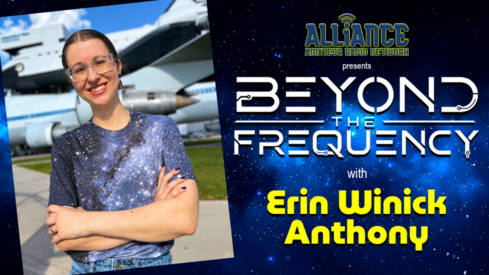
Clear Signal: Erin Winick Anthony on Telling Science Stories
A conversation about radio, the ocean floor, and why the hobby has a story problem — not a technology problem.
Why this conversation matters
Ham radio has a story problem, not a technology problem. The hobby has digital modes, SDRs and satellites, but outsiders still picture a guy in a basement surrounded by boat anchors, speaking in Q-codes nobody translated.
We think that story is costing us people.
Every one of us got hooked by a moment, like a faraway voice coming out of the speaker. We don’t share that spark enough with the people who’d love it most: the kid building things in the garage, the girl who wants to be an astronaut, the student who has never seen someone like them holding the mic.
That’s why we wanted to talk with Erin Winick Anthony. She isn’t a ham (not yet, anyway), but her career is about taking technical things and making people feel them, first at NASA and now at sea. Last year she also helped connect a research ship in the middle of the Pacific to an astronaut overhead. By radio.
An ARISS contact, the kind our volunteers make happen all the time, became a highlight of an ocean expedition. That’s our story. We just don’t always tell it well. So here’s our challenge: find your spark again, then go show somebody. Tell it like it matters. Because it does.
Two days out from nowhere
When we caught up with Erin in late August, she was in the control van of the E/V Nautilus, two days into a nine-day transit from Wake Island to Honolulu. “Truly in the middle of the Pacific right now,” she said with a laugh.
Erin was lead science communication fellow for Ocean Exploration Trust, which runs Nautilus. The expedition spent about two weeks around Wake Island, a U.S. territory with no permanent residents and maybe 300 visitors a year, exploring its biology, geology and archaeology. The seafloor there is largely a blank spot on the map. Only about 28% of the ocean floor has been mapped in detail, up from roughly 16% in 2013.
She worked the 12-to-4 watch, midnight to 4 and noon to 4, fielding questions from the live stream and helping scientists explain their work. Thirty-one days, seven days a week. “You want to make the most of every second,” she said.
Here’s the part hams will appreciate: Nautilus streams its dives live over VSAT and Starlink, with only about a seven-second delay from thousands of meters down. Scientists on shore join in real time, sometimes flagging possible new species before the crew aboard does.
Her favorite moment came at the end of a long descent through “blue water.” The camera on Atalanta, which hovers above the main ROV Hercules, spotted something in the distance. Up close, it was an octopus about a meter long, seemingly waiting for them. “It almost looked like a little ghost in the camera view,” Erin said. “I felt like it was welcoming us down to the seafloor.” Hearing the clip later, with her own voice among the excited ones Nautilus viewers know so well, was its own thrill. “It’s cool to be a part of that legacy.”
Engineer by training, storyteller by choice
Erin nearly majored in journalism but chose engineering because she loved building things, figuring she could always circle back to writing. Internships at John Deere, Caterpillar and two engineering firms taught her what she didn’t want: a design desk. What lit her up was helping engineers communicate. So after graduation she skipped the usual job hunt, freelanced, ran a small 3D-printed science jewelry business, and landed an internship writing for The Economist in London.
That opened the door to reporting at MIT Technology Review, then nearly four years communicating space station science for NASA. She’s proudest of the NASA Explorers: Microgravity video series and a reader-friendly redesign of the station’s Benefits for Humanity report. Today she runs STEAM Powered Media, with clients like Astrolab, Zero-G, Space Center Houston, the International Ocean Discovery Program and Hearst.
Her advice for content creators
Show genuine excitement. It’s the biggest hook you have. If you’re not lit up about what you’re sharing, no one else will be either.
Earn the first ten seconds. Would you keep watching? That question decides whether anyone else does.
Save the credentials. Hook first, introduce yourself later. Nobody waits through a bio to get to the good part.
Give them something to look at. Hold the part up to the camera. Show the thing, not just yourself talking about the thing.
Ship to space, by way of ARISS
Last October, on her previous Nautilus expedition, Erin and several crewmates made a contact with NASA astronaut Zena Cardman. That contact was made possible by an organization hams know well — ARISS (Amateur Radio on the International Space Station). Cardman, whose amateur call sign is KJ5CMN, had sailed on Nautilus herself years earlier. The idea started at a NASA retirement party: the ship does ship-to-shore calls all the time, so why not ship-to-space? Out that far, the astronauts overhead were the closest humans around. Erin credits the ARISS volunteers who wrangled the time zones.
Ham radio had already made space feel real for her. In her first weeks at NASA, a coworker pulled out a radio as the station passed over, and she listened to astronaut Drew Morgan talk with a group of elementary schoolers.
Erin isn’t licensed yet, though she nearly got her ticket at NASA, where licensed teammates could use backup operators. She sees hams as kindred spirits to her pinball crowd: “The people that are going to want to repair a 1950s pinball machine also feel like the type of people that are going to want to connect with people via ham radio.” Her verdict: “Never say never.” If she does it, she’ll likely make a video of the journey. We’d be glad to help, Erin.
Who gets to be in the picture
AARN’s mission is opening doors in radio and STEM for women, people of color, LGBTQ+ folks and anyone unsure there’s a seat for them. Erin’s answer on inclusion is simple: put the people who are already there front and center, often without making a big announcement about it. On this trip, a sunset group photo turned out to be all women, from ROV pilots to biologists. Nobody planned it.
Her own role models ranged from Bill Nye and the MythBusters to Sally Ride, Peggy Whitson and Nicole Stott. Growing up in Tampa, she felt shuttle sonic booms rattle the family’s glass doors, and in sixth grade she met Neil deGrasse Tyson like he was a Beatle. With a family split between engineers and teachers, she says she found her way to the middle.
Turning a closed door into an open one
Erin has ranked among the top 100 women in competitive pinball, a hobby that, like ham radio, can look like a wall of jargon from outside. When she started, everything she found was for experts, so she made videos answering beginner questions: What happens at a tournament? Is it okay to finish last? Show newcomers it’s often just 20 friends at an arcade, and they’ll think, I can do that. Swap “arcade” for “Field Day site” and the lesson holds.
Her advice for a kid who doesn’t see themselves yet
To young people who don’t see themselves in these fields yet: find people doing what interests you, especially locally, and reach out with a specific question. “If there is a scientist in your local community, they’re not getting reached out to every day from someone like you.” And say your dreams out loud to teachers, coaches and parents. The more people know, the more doors can open.
Her parting words for our community: branch out. She came from engineering and space, and now she’s mapping the Pacific floor. “You’ll never know what you’ll find.”
Fair winds, Nautilus.
Join the Alliance Net
Wednesdays @ 9 PM Eastern
The Biggest Campfire on Earth
Jamboree On The Air: Then and Now
One Weekend in October
Spin the dial on the third full weekend of October and you’ll notice something odd. The bands get crowded. Not with the usual contesters barking out serial numbers, but with kids — lots of them — a little nervous, a little giddy, trying to remember which way the phonetic alphabet goes after “Kilo.”
That’s Jamboree on the Air. JOTA, if you’ve been around Scouting or ham radio long enough to talk in acronyms. It bills itself as the biggest Scouting event in the world, and honestly the numbers back that up: more than 1.3 million Scouts and Guides, spread over 170-plus countries, all trying to raise each other at once.
I like to think of it as one enormous campfire. Except the fire is the ionosphere, and nobody has to share a tent.
Birmingham, England, 1957
Like a lot of good ideas, this one started with somebody just watching. The year was 1957, and Scouting was turning fifty. To mark the occasion, the 9th World Scout Jamboree set up camp in Sutton Park, near Birmingham, England — and somebody had the bright idea of putting a ham station on site. It ran under the callsign GB3SP. Among the operators was a British amateur and Scout leader named Leslie R. Mitchell, G3BHK.
What Mitchell saw stuck with him. Scouts kept crowding around that station, fascinated, wanting a turn at the mic. And he started doing some math in his head (the kind of math that leads to trouble, in the best way). A World Jamboree only came around every four years. Only a sliver of the world’s Scouts could ever afford to go. But radio? Radio didn’t care about plane tickets.
So he pitched it: a “Jamboree on the Air.” Same spirit, no travel, every single year.
From Trial Run to Tradition
The World Scout Committee didn’t need much convincing. The first official JOTA ran May 9–11, 1958, and it took off right away. Hams all over the place volunteered their shacks, their rigs, and — this part matters — their licenses, so local troops could actually get on the air. For thousands of kids, that was the first time the world felt reachable from their own backyard.
May didn’t last, though. Propagation tends to be friendlier in the fall, and October fit better around the school year anyway, so the event found a permanent home: the third full weekend of October. This year, that’s October 16–18.
The technology kept moving under it. Early JOTA was Morse and voice, AM and SSB. Then came amateur television. Satellites. Packet radio. Every new mode got folded in, but the point never really changed — make friends across borders, and maybe trick a few kids into learning some physics along the way.
Then the Internet Showed Up
By the mid-90s, kids were discovering a different kind of network. Dial-up tones instead of static. The World Scout Committee noticed, and in 1996 it officially launched Jamboree on the Internet — JOTI. It ran right alongside JOTA, using web chats, forums, and whatever the early internet had to offer at the time (which, let’s be honest, wasn’t a whole lot). But it mattered. A troop with no ham club nearby, no licensed operator to lean on, could suddenly join in.
Somewhere along the line the two stopped being separate things. Now it’s just JOTA-JOTI, one big weekend with a lot of doors in.
Still Keying Up
It’s been almost seventy years since Leslie Mitchell watched a bunch of kids crowd around GB3SP and thought, huh, what if.
The gear’s unrecognizable now. The promise isn’t. JOTA-JOTI still tells millions of young people, every October, that they belong to something bigger than their own town — a family that just happens to be scattered across the whole planet. The world feels pretty split up some days. I’ll take any weekend that stitches a little of it back together, one “CQ Jamboree” at a time.
Here’s the part I find quietly wonderful, though. Every one of those kids is standing next to a licensed operator who’s explaining, in real time, why the signal is fading, or what an antenna actually does, or why you say “over” (and when you really shouldn’t). That’s radio physics and electronics and on-air manners, taught by somebody’s neighbor on a Saturday afternoon.
And for some of them, it sticks. They go home and chase the Radio Merit Badge. A few years later, some of them sit for their own license exam. Not bad for one weekend, is it?
What a Scout Actually Does All Weekend
Radio is still the heart of it. That hasn’t changed, and I hope it never does. But a Scout showing up to JOTA-JOTI today has options:
- Work another Scout on HF — maybe someone a few thousand miles off, maybe someone two states over. Both count, both are a thrill the first time.
- Try a satellite contact — or, if the stars line up, talk with the International Space Station.
- Hop into moderated online chat rooms and video servers to play games with a troop on the other side of the planet.
- Sit in on global webinars about the environment, clean energy, and humanitarian service.
JOTA-JOTI Quick Facts
The Through-Rock Radio That Saved a Life
A ten-hour cave rescue in Alberta proved that low-frequency digital radio can do what no conventional system can — communicate straight through solid rock.
The Psych Squeeze Crisis
A dramatic ten-hour rescue operation at Rat’s Nest Cave near Canmore, Alberta has proven to be a historic milestone for both search-and-rescue tactics and amateur radio engineering. On August 15, 2026, an individual participating in a guided excursion became severely wedged feet-down in a notoriously tight, undulating vertical fissure known to regional spelunkers as the “Psych Squeeze.” The cave’s tight geometry and freezing drafts created an immediate life-safety hazard, necessitating a complex technical extrication.
As elite responders meticulously used hammer drills and chisels to delicately fracture the limestone matrix surrounding the pinned victim, an experimental, volunteer-built digital radio system successfully transmitted telemetry and situational updates directly through the earth. This breakthrough provided a real-time communications link that completely bypassed the severe geological barriers that typically blind rescue operations, keeping surface command and underground tactical teams in flawless synchronization throughout the grueling ordeal.
Because traditional communications are instantly swallowed by deep limestone, early stages of operations like this usually leave command staff completely blind, operating on outdated updates delivered hours late by physical messengers. In this instance, however, the establishment of a continuous, high-reliability data link fundamentally transformed the tactical timeline. Underground medical personnel were able to transmit continuous vital signs and psychological assessment logs directly to medical control at the staging area above ground. Simultaneously, structural engineers on the surface closely monitored the depth, vibration impact, and positional metrics of the drilling teams, offering immediate diagnostic adjustments.
The Limits of Traditional Comms
Deep underground environments present a near-total barrier to standard communications infrastructure. Traditional VHF/UHF hand-held radios, cellular devices, and satellite-linked GPS units all rely on high-frequency, line-of-sight electromagnetic waves that are quickly attenuated, scattered, or completely blocked by dense rock formations. Historically, subterranean rescue teams have been forced to deploy physical “runners” to sprint messages back and forth to the cave entrance, or painstakingly string kilometers of physical telephone wire through jagged, muddy passageways — methods that introduce dangerous logistical delays and physical liabilities.
To overcome these environmental constraints, the rescue teams deployed highly modified QDX-M digital transceiver kits, originally engineered by QRP Labs. Operating on ultra-low frequencies (ULF), these innovative units leverage long wavelengths capable of penetrating more than 500 meters of solid rock without the severe signal degradation suffered by higher bands. Rather than relying on analog voice — which requires a much wider bandwidth and is prone to static and noise floor interference deep underground — the system utilized a specialized digital mode to transmit highly compressed text messages and status updates directly through the mountain.
A Flawless Extrication
This seamless data link allowed underground teams from Alberta/BC Cave Rescue and Canmore Fire Rescue to coordinate directly with surface command. Using hammer drills, rescuers carefully removed the surrounding rock matrix to extricate the individual at a rate of just inches per hour, all while surface medical and logistical assets remained perfectly synced with their progress. By midnight, the trapped tourist was successfully freed and able to walk out of the cave under his own power, requiring no hospitalization.
This successful deployment represents the first real-world operational validation of the QDX-M system in a life-safety scenario, proving that low-frequency digital signaling can reliably conquer the most challenging subterranean environments.
How NASA’s Newest Antenna Inspires Ham Radio
Deep Space Station 23 at the Goldstone Complex — and what it shares with your homebrewed microwave station.
Barstow, CA — Late August saw the addition of Deep Space Station 23 (DSS-23) — a new 34-meter antenna at the Goldstone Complex in California. This marks a massive leap forward for NASA’s Deep Space Network (DSN). While this facility is built to track cutting-edge lunar and interplanetary missions, its deployment resonates deeply with the global amateur radio community. For decades, the boundary between professional deep-space communication and amateur radio exploration has been bridged by a shared passion for weak-signal propagation, high-gain antennas, and the thrill of pulling data out of cosmic noise.
Technically, DSS-23 is a multifrequency beam-waveguide antenna designed to handle the core pillars of deep-space communications: S-band (2.29–2.30 GHz), X-band (8.40–8.50 GHz), and Ka-band (31.8–32.3 GHz). It is engineered to direct these precise microwave signals down through a series of mirrors into a stable, underground climate-controlled room rather than housing sensitive, heavy electronic receivers directly on the moving dish. Furthermore, DSS-23 features an experimental component designed to co-locate near-infrared optical laser reception alongside standard radio frequencies.
Amateur radio operators — particularly those involved in Earth-Moon-Earth (EME) “moonbounce” communications and amateur microwave experimentation — look at this architecture with immense technical admiration. Amateurs routinely operate on adjacent allocations, such as the 13-centimeter band (2.3–2.4 GHz) and 3-centimeter band (10 GHz), utilizing scaled-down variants of the very same low-noise amplifiers (LNAs) and parabolic feed horns optimized by NASA.
As NASA pushes toward the Moon with the Artemis program, the amateur satellite community (AMSAT) is preparing its own small-satellite payloads destined for high-Earth and lunar orbits. The expanded tracking capacity provided by DSS-23 ensures a robust infrastructure for the entire lunar space ecosystem, keeping the dream of citizen-science tracking and deep-space amateur listening alive for the next generation of radio enthusiasts.
In an era dominated by commercial satellite constellations and proprietary digital networks, the activation of DSS-23 reminds us what radio communications are truly about. NASA’s giant dish is a testament to human curiosity, but it shares its core DNA with the modest wire antennas and homebrewed microwave stations constructed by hams worldwide.
Amateur radio remains the ultimate grassroots laboratory for exploring the spectrum. When NASA pushes the limits of microwave engineering, they validate the exact same physics that amateur operators tinker with every weekend. DSS-23 doesn’t just listen to the stars for a handful of scientists; it inspires hobbyists to keep pointing their own arrays toward the sky, proving space exploration belongs to anyone willing to listen.
Resources
Volunteer with ARDC in 2027
Amateur Radio Digital Communications (ARDC) is accepting volunteer applications through October 30, 2026 for 2027 roles. Open positions include the Grants Advisory Committee, Technical Advisory Committee, Grants Evaluation Team, Grants Communications Team, and Conduct Review Committee.
Applicants need an amateur radio license, technical degree, or experience in digital communications. Global volunteers welcome — remote participation, January through December 2027. Up to four consecutive terms.
Apply at: forms.gle/sWBt8TZdKc3VgNgA9
Upcoming Radio, Tech & Computing Events
| Event | Dates | Location | Info |
|---|---|---|---|
| Jamboree On The Air / JOTA — World Scouting | Oct 16–18 | Worldwide | jotajoti.info |
| ZERO Retrics Digital Conference | Oct 16 | Roundhouse Conference Center, San Ramon, CA | zeroretrics.org/p/conference |
| Pacificon | Oct 16–18 | San Ramon Marriott, San Ramon, CA | pacificon.org |
| Open Source AI Week | Oct 16–25 | Bay Area — Various Locations, San Francisco, CA | opensourceaiweek.com |
| ALL THINGS Open | Oct 19–20 | Raleigh Convention Center, Raleigh, NC | 2026.allthingsopen.org |
| oSTEM Annual Conference | Oct 22–24 | Albuquerque Convention Center, NM | conference.ostem.org |
| Texas Linux Festival | Nov 6–7 | UT-Austin Commons Event Center, Austin, TX | 2026.texaslinuxfest.org |
| FtWayne Hamfest & Computer Expo | Nov 21 | Allen Co. War Memorial Coliseum, Fort Wayne, IN | fortwaynehamfest.com |
| HamCation Orlando | Feb 12–14, 2027 | Central Florida Fairgrounds & Expo Park, Orlando, FL | hamcation.com |
Loading Viewer…
Loading Viewer…
Loading Viewer…
Loading Viewer…
Prior Months
Loading Viewer…
Loading Viewer…
Loading Viewer…

Author: Scott - KC1MUR
General class operator
No responses yet