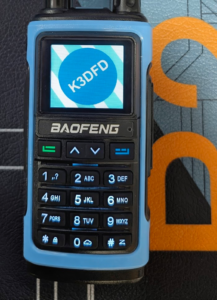
Is this the new entry level CCR?
The Beofeng UV-5R is probably the most common entry point into Ham Radio. But maybe your first radio should be the new UV-7B instead. Here’s some practical thoughts –
Recently Amazon had it discounted, from the Beofang store, for a measly $27.19. The UV-5R is $16.07 – about ten bucks less. But neither is going to break the bank, so why is the -7B a better deal? Primarily a third band for just a few dollars more than the -5R.The little UV-5R gives you 136–174 MHz and 400–520 MHz, but the newer and a heftier UV-7B adds 220-260 MHz – and a color screen! Sure, most inexpensive handhelds are able to receive airband and NOAA weather, but a tribander in the sub $30 range is a great deal.
But what about the big 10 watt UV-32 with GPS that’s still in the basement price range? Well, it is just that – big. Some say it’s too big to easily haul around in your pocket. I have one and yes, it is a bit of a pain to carry around. Beofeng has a lot of radios to sell you. Many others, like the UV-5RM Plus GPS add, well you guessed it GPS, and can still be purchased for around $35. GPS on an HT is mostly for people using APRS.
In addition to the frequency coverage, the specs on the UV-7B are pretty decent – 1000 channels, up to 5 watts – I guess that depends on what band you’re transmitting on. We’d need to sit down with some test gear for that. It comes as no surprise that Beofeng specs are…estimates. Funny thing is the official Beofeng manual doesn’t seem to align with the marketing wording. Beofeng markets the -7B radio for VHF, 1.25m (220) and UHF but the book doesn’t mention 1.25 meters in transceive. But I can tell you from experience, that I can hit one of my local 220 repeaters reliably. So maybe Beofang did a cut-n-paste job on the manual.
Some other comparisons for fun – The receiver sensitivity on the UV-5R is stated in the manual as 0.2 microvolts at -12db SINAD. The UV-7B however states it as -120dBm at -12db SINAD. So stated this way, how do these compare?
Well, the little UV-5R at 0.2 µV is essentially -121 dBm, and the UV-7B is rated at -120 dBm. That’s a difference of only 1 dB — and for all practical purposes, these two radios have virtually identical receiver sensitivity. One dB is right at the threshold of human perception in audio, so neither radio has a meaningful sensitivity advantage over the other, at least in my humble opinion.
The UV-7B says it has a -16 dBm spurs below 1GHz, which I think reaches the 25 microwatt point. So if the radio is transmitting 5 watts (37 dBm), then -16 dBm spurious means it’s roughly 53 dB below the carrier.
That’s fine, but nothing to brag about, but a bit better than the little UV-5R, from what I can gather from both radio’s manuals.
FCC Part 97 requirement for amateur HTs under 5W is at least 40 dB below the fundamental. So technically at 53db below, the -7B complies. But given these are budget Baofengs, real-world measurements by the amateur radio community have often shown their spurious emissions claims to be, well let’s just say…optimistic. But in a day-to-day usage scenario, the UV-7B, which is just a tad more expensive than the dirt-cheap UV-5R has some wins. First, it feels good in your hand. It is sized just right and has a surprising higher quality feel that you’d expect.
The -7B weighs about a half a pound, so no one can call it a lightweight. It will fit into bigger pockets even with the belt clip. Not quite as easily as the little -5R but a lot easier than its bigger siblings.The case is a pretty baby blue polycarbonate – the only color unfortunately. You really can’t compare the build quality of any Beofeng to say, an old metal-cased Yaesu FT-270 or even an AnyTone D878UV II Plus, but for the incredibly low price, it is a solid radio with a decent 1.77″ TFT screen.
BTW, If you’ve ever seen the big Beofeng UV-32 or its DMR DM-32’s screen go dark in bright daylight, the -7B’s screen doesn’t wash out in the same way.
Finally, to program the radio from your PC, you will need a type K USB interface cable – which is the old Kenwood style. These cables are all over Amazon, but just buy the one sold from Beofeng and you’ll be good to go without grief. Trust me on this.
It does have Bluetooth connectivity, but only for its Android app – which I tried on my Pixel 8. It failed to connect about half the time. Your results may be better depending on your phone brand. I haven’t tried it on an iPhone. Beofeng has its own programming application for PC that you can download from their website. I’ve heard lots of complaints about it being buggy. I’ve tried it and it isn’t that bad. But you can use Chirp instead, which is how I program all of my supported radios. The only thing is that, as of this writing there is no radio definition for the UV-7B specifically. So you use the definition for the UV-21 Pro GPS instead. There is also a utility to let you upload a simple 150x128px bitmap picture of your choosing. Cute.
If you’re looking at the venerable UV-5R as your first HT, you should have a look at the UV-7B as well and make some comparisons. For only a few bucks more, I think you get a lot more radio.
Dave K3DFD

No responses yet