Alliance Amateur Radio Network
QRV Monthly
Member Newsletter
From Curiosity to Connection: An Amateur Radio Journey
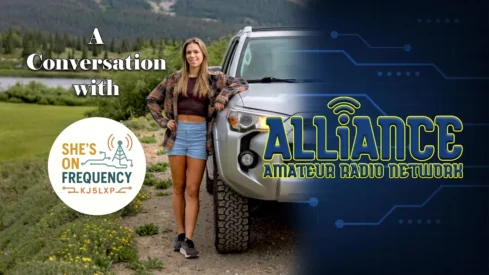
A Conversation with Elle-Marie DeFrain, KJ5LXP — Creator of She’s on Frequency
Amateur radio has always been about more than just signals and equipment — it’s about people, curiosity, and connection. But just as importantly, it’s about who feels welcome to be part of that experience. That spirit of inclusion comes through clearly in the Alliance Amateur Radio Network’s recent interview with Elle-Marie Dufresne (KJ5LXP). Her story isn’t just inspiring — it’s a reminder of why representation and accessibility matter in this hobby.
A Natural Fit for Technology — and a New Perspective
Elle-Marie’s background blends technical skill with lived experience in a way that feels both relatable and refreshing. She studied computer engineering and now works as a software developer and product owner, but she also brings the mindset of a former collegiate athlete — disciplined, resilient, and team-oriented.
She credits her father, a software developer who worked remotely long before it was common, as a major influence. Watching that lifestyle helped shape how she views technology — not just as a career, but as a tool for freedom and flexibility.
Importantly, she doesn’t try to fit into a pre-existing mold within amateur radio. She shows up as her full self — technical, creative, and active — and that’s exactly what helps broaden the space for others.
“I was mystified by the idea of talking through the ionosphere… to people all the way across the world without cell service.”
Finding Radio at the Right Moment
Radio came into Elle-Marie’s life during a period of transition. After stepping back from high-level athletic pursuits due to injuries, she was looking for something new — something engaging but sustainable.
That opening came through her husband, who was researching communication options for hunting trips in areas with poor cell service. Amateur radio surfaced as a solution, but for Elle-Marie, it quickly became something more.
She was captivated by the concept itself. What really hooked her was the unpredictability: “It’s like a box of chocolates. You don’t know what you’re going to get each day because of propagation.” In a world where most technology is instant and reliable, she found something refreshing in a system that still carries a bit of mystery.
Learning, Motivation, and Owning the Process
Elle-Marie didn’t just casually explore radio — she leaned into it. She genuinely enjoyed studying for her license, describing it as a return to something she missed. Then came a moment that added both humor and motivation: after encouraging her dad to get licensed, he beat her to it — and proudly showed it off. That sparked a competitive push to finish what she started.
With a trip to Colorado approaching, she set a firm goal to get licensed before leaving. She followed through, driven not just by interest but by purpose — wanting reliable communication for travel and a deeper connection to the hobby.
That First Contact — And Why It Matters
Her first experience on the air is one of those moments that sticks. After receiving her call sign, she programmed a repeater into her handheld radio and made her first transmission. On the other end was another woman — something that immediately stood out.
That moment wasn’t just technical — it was personal. It reinforced that she had a place in the hobby. And it quickly led to an invitation to a local club breakfast the very next day.
Walking Into the Community
Attending her first club meeting, Elle-Marie wasn’t sure what to expect. What she found was a full room of operators — far more than she anticipated. She admits she was nervous walking in: “I didn’t know what to expect. I didn’t know who to look for.” That feeling is familiar to many newcomers, especially those entering spaces where they may not immediately see themselves represented. But that uncertainty didn’t last long.
What stood out most was the depth of knowledge and enthusiasm: “I was really inspired by everyone’s knowledge in the room… I was like, oh, that’s cool… I should do something too.” As one of the younger operators, she noticed the age gap — but chose to see it as an advantage. Being surrounded by experienced operators became an opportunity to learn, not a barrier to entry.
Creativity Has a Place Here
One of the most compelling parts of Elle-Marie’s story is how she blends creativity with amateur radio. As a photographer, she brings a strong visual and storytelling approach to her YouTube channel. That perspective makes her content feel approachable and human — something that can make a real difference for people who might otherwise feel intimidated by the hobby.
Her presence reinforces an important truth: amateur radio isn’t just for one type of person. It’s for builders, storytellers, explorers, and learners alike.
Why Stories Like This Matter
Elle-Marie represents something bigger than just a new operator — she represents a new pathway into amateur radio. She didn’t grow up in the hobby. She discovered it, explored it, and made space for herself within it. And in doing so, she’s helping others see that they can do the same.
Because when people hear stories like hers, it lowers the barrier to entry. It sends a clear message: there is no single way to belong in amateur radio.
The Wilderness Protocol
A lifeline when repeaters can’t reach you — and it’s not just for hikers.
Picture this: you’re three days into a backcountry trip, miles from the nearest trailhead, and something goes wrong. You key up your radio and hear nothing but static. No repeater, no response, no luck. This is exactly the situation the Wilderness Protocol was designed for — and it’s one more reason every ham radio operator should know about it.
The Wilderness Protocol is a simple, community-driven agreement among amateur radio operators. The idea is straightforward: when you’re outside repeater range, you monitor specific simplex frequencies at specific times, so that anyone needing help actually has a chance of being heard. No infrastructure required. No internet connection. Just operators looking out for each other.
The Primary Frequency and When to Listen
The main frequency is 146.52 MHz, the standard national simplex calling frequency. Secondary frequencies are 52.525, 223.5, 446.0, and 1294.5 MHz. If your radio supports it, scanning all of them costs you nothing.
The recommended monitoring schedule runs every three hours starting at 7:00 AM local time — so 7, 10, 1, 4, 7, and 10. At each of those times, you listen for five minutes. Thirty minutes out of your entire day. One practical tip: some operators tune in five minutes before the hour and stay until five minutes after, to account for the fact that not everyone’s watch agrees with everyone else’s.
How Calls Actually Work
There’s a deliberate order of operations here. For the first four minutes of each monitoring window, everyone listens. Only after those four minutes should anyone start making general CQ-style calls. The logic is sensible: if someone is in trouble, you want the channel clear and ears open before anyone starts chatting.
Emergency and priority calls are different entirely. Those don’t wait — they go out immediately, preceded by LiTZ (Long Tone Zero). You simply hold down the zero key on your DTMF pad for about ten seconds, sending a continuous tone before you begin speaking. That tone cuts through the noise and signals to anyone monitoring that something important is coming. Think of it as the radio equivalent of raising your hand before you speak, except the stakes are considerably higher.
One more thing: 146.52 is a calling frequency, not a conversation frequency. Make your call, establish contact, then move to a working frequency like 146.55 or 146.43 to keep the primary channel stays available for others.
It’s Not Just for Hikers
The name creates a bit of a misleading impression. Yes, it was originally conceived for hikers and backpackers venturing into areas where repeaters simply don’t exist. But the protocol applies anywhere repeater coverage fails — whether that’s a remote rural area, a situation where local repeaters have gone offline during a disaster, or anywhere else the usual infrastructure isn’t available.
The honest truth about the Wilderness Protocol is that its value scales directly with participation. An emergency call on 146.52 at 10 AM means nothing if no one is listening. The more operators who build this monitoring habit into their radio routine, the more effective the whole system becomes. It asks very little and offers something genuinely valuable in return: the knowledge that if you ever key up in a bad situation, someone out there is probably listening. That’s a pretty good deal.
Creation of the Protocol
The Wilderness Protocol was created by The Honorable William H. Alsup, N6XMW, a U.S. District Court Judge. In the February 1994 edition of QST magazine, he wrote an article proposing a Wilderness Protocol “for effective simplex use of handheld VHF and FM transceivers in the backcountry.” In August 1995, he reported enthusiastic support of the proposal and reminded us to spread the use of the protocol. Hon. William Alsup was originally appointed to the U.S. District Court in Northern California by Pres. Bill Clinton in 1999. Alsup assumed inactive senior status on December 31, 2025.
Quick Reference
A Much-Needed Scholarship Opportunity
The AARN Amateur Radio & STEM Excellence Scholarship — spread the word.
The Alliance Amateur Radio Network has announced a new scholarship aimed at expanding diversity in both amateur radio and STEM fields. The AARN Amateur Radio & STEM Excellence Scholarship will support high school seniors from underrepresented communities as they pursue college-level STEM education — reflecting AARN’s longstanding belief that the amateur radio community is richer, stronger, and more innovative when it truly includes everyone.
At a time when the demand for STEM talent is greater than ever, the pipeline of diverse graduates entering these fields remains stubbornly narrow. Women, minority, and LGBTQ+ students continue to be underrepresented both in STEM classrooms and on the airwaves, and that gap carries real consequences — not just for individuals who miss out on opportunity, but for the fields themselves, which lose the perspectives, creativity, and problem-solving that diversity brings. AARN created this scholarship as one concrete step toward closing that gap.
The award targets female, BIPOC, and LGBTQ+ students who come from low-income (Pell Grant-eligible) households and plan to enroll full-time in a STEM degree program in Fall 2027. Eligible fields are broad and inclusive, ranging from electrical engineering, computer science, and cybersecurity to physics, mathematics, environmental science, and biomedical engineering.
While holding an FCC Amateur Radio License is preferred, it is not a hard requirement. Students without a license may still apply, provided they commit to earning at least a Technician class license before graduation. This is a deliberate choice by AARN to keep the door open for passionate students who are still finding their footing in the hobby.
The scholarship award will be disbursed as a single payment directly to the recipient’s institution. Applicants must be U.S. citizens, nationals, or permanent residents enrolled at an accredited college or university.
AARN is calling on all of its members to help spread the word. If you know a young person who belongs on the airwaves, share this opportunity with them, their parents, or their school counselor. Post it on your club’s bulletin board, mention it at your next meeting, and pass it along to teachers in your network. Every conversation could change a life.
| Date | Milestone |
|---|---|
| Jan 15, 2027 | Application period opens |
| Mar 15, 2027 | Application deadline |
| Jun 1, 2027 | Recipients announced |
Dates are tentative and subject to change. Full details and applications will be available at scholars.allianceamateur.org.
73 to the Moon: Ham Radio Operators and the Lunar Legacy
From backyard antennas to Orion spacecraft, hams have always had their ears pointed at the Moon.
When Neil Armstrong stepped onto the lunar surface in 1969, the world watched on TV — but Larry Baysinger, W4EJA, was doing something more remarkable. With a rebuilt Army surplus tank radio and a chicken-wire antenna, he picked up the weak VHF signals from Armstrong’s backpack radio on the Moon, listening for 35 minutes and even hearing President Nixon’s congratulations — five to ten seconds ahead of the broadcast. The ham heard the Moon before Walter Cronkite did.
The first ham in space was Owen Garriott, W5LFL, who in 1983 called a station in Frenchtown, Montana from orbit. That spark grew into ARISS, which has since connected thousands of schoolchildren with astronauts aboard the ISS.
Now, for the first time since Apollo, hams have had three seats on a lunar mission. Artemis II NASA crew members Reid Wiseman (KF5LKT), Victor Glover (KI5BKC), and Canadian Space Agency crew member Jeremy Hansen (KF5LKU) are all licensed operators. No amateur gear flew this time — but the community will be listening just the same.
The Alliance Net is Going LIVE!
Opening the airwaves to everyone — no license, no radio, no setup required.
Amateur radio has long carried a reputation as a hobby for the already-initiated — a world of callsigns, licensing exams, and specialized equipment that can feel intimidating to outsiders. At AARN, we’re challenging that perception with a move that’s small in execution but significant in spirit.
Beginning April 22, 2026, AARN will begin livestreaming our weekly nets on YouTube, making them accessible to anyone with an internet connection — no license, no radio, and no technical setup required.
This matters most for two groups of people. The first is the aspiring ham: someone grinding through their Technician or General exam who wonders whether the community is worth joining. Rather than imagining what a net sounds like, they can simply tune in, hear real operators in real conversation, and decide for themselves. The second group is perhaps even more important — those who have never considered amateur radio at all. A YouTube livestream reaches people who would never have stumbled across the hobby otherwise, and our laid back, friendly atmosphere is exactly the right first impression.
For those already licensed, the digital on-ramps remain fully available via TGIF, Allstar, Echolink, and YSF. The livestream complements those modes by ensuring that no stage of a person’s amateur radio journey — from total newcomer to seasoned operator — is left without a way to connect with us.
We aren’t just broadcasting a radio program. We’re extending an invitation — and in a hobby that thrives on community, that may be the most powerful transmission we’ve ever made.
Upcoming Hamfests, Expos & Conferences
| Event | Dates | Location | Info |
|---|---|---|---|
| Dayton Hamvention | May 15–17 | Green Co. Fairgrounds, Xenia, OH | hamvention.org |
| SEA-PAC Hamfest | Jun 2–4 | Seaside Civic Center, Seaside, OR | seapac.org |
| SouthEast LinuxFest | Jun 12–14 | Sonesta Charlotte, Charlotte, NC | southeastlinuxfest.org |
| Ham Radio International Expo | Jun 26–27 | Friedrichshafen, Germany | hamradio-friedrichshafen.com |
| ARRL Field Day | Jun 27–28 | Nationwide | arrl.org/field-day |
| Northeast HamXposition | Aug 13–16 | Best Western Royal Plaza, Marlborough, MA | hamxposition.org |
| Hackers On Planet Earth (HOPE 26) | Aug 14–16 | The New Yorker Hotel, NYC | hope.net |
| Huntsville Hamfest | Aug 22–23 | Von Braun Center, Huntsville, AL | hamfest.org |
| Pacificon | Oct 20–22 | San Ramon Marriott, San Ramon, CA | pacificon.org |
| oSTEM Annual Conference | Oct 22–24 | Albuquerque Convention Center, NM | conference.ostem.org |
Loading Viewer…
Prior Months
Loading Viewer…
Loading Viewer…
Loading Viewer…

No responses yet